Heads Up, Ears Down

This blog accurately identifies depictions of violence and cruelty toward animals in films. The purpose is to provide viewers with a reliable guide so that such depictions do not come as unwelcome surprises. Films will be accurately notated, providing a time cue for each incident along with a concise description of the scene and perhaps relevant context surrounding the incident. In order to serve as a useful reference tool, films having no depictions of violence to animals will be included, with an indication that there are no such scenes. This is confirmation that the films have been watched with the stated purpose in mind.


Note that the word depictions figures prominently in the objective. It is a travesty that discussions about cruelty in film usually are derailed by the largely unrelated assertion that no animals really were hurt (true only in some films, dependent upon many factors), and that all this concern is just over a simulation. Not the point, whether true or false. We do not smugly dismiss depictions of five-year-olds being raped because those scenes are only simulations. No, we are appalled that such images are even staged, and we are appropriately horrified that the notion now has been planted into the minds of the weak and cruel.


Depictions of violence or harm to animals are assessed in keeping with our dominant culture, with physical abuse, harmful neglect, and similar mistreatment serving as a base line. This blog does not address extended issues of animal welfare, and as such does not identify scenes of people eating meat or mules pulling plows. The goal is to itemize images that might cause a disturbance in a compassionate household.


These notes provide a heads-up but do not necessarily discourage watching a film because of depicted cruelty. Consuming a piece of art does not make you a supporter of the ideas presented. Your ethical self is created by your public rhetoric and your private actions, not by your willingness to sit through a filmed act of violence.

Showing posts with label Hungarian. Show all posts

Werckmeister Harmonies

Werckmeister Harmonies (Werckmeister harmóniák). Béla Tarr and Ágnes Hranitzky, 2000.

😸

Edition screened: Criterion 4K UHD #1215, released 2004. Hungarian language with English subtitles. Runtime approximately 145 minutes.


Summary: No particular depictions of violence or harm to animals. A taxidermy whale figures prominently but there is nothing visually alarming.


The BD in this dual format Criterion release also includes Tarr’s Family Nest (1979).


Family Nest

Family Nest (Családi tüzfészek). Béla Tarr, 1979.

😸

Edition screened: Included on Criterion Blu-ray # 1215 Werckmeister Harmonies, released 2024. Hungarian language with English subtitles. Runtime approximately 108 minutes.


Summary: No particular depictions of violence or harm to animals.

Twilight (Fehér)

Twilight (Szürkület). György Fehér, 1990.

😸

Edition screened: Second Run Blu-ray, released 2023. Hungarian language with English subtitles. Runtime approximately 101 minutes.


Summary: No particular depictions of violence or harm to animals.


Szinbád

Szinbád. Zoltán Huszárik, 1971.

😸

Edition screened: Second Run DVD #058, released 2011. Hungarian language with English subtitles. Runtime approximately 90 minutes.


Summary: No particular depictions of violence or harm to animals.


The Second Run DVD also includes Peter Strickland’s Szinbád: An Appreciation (2010, 12 minutes).


Sátántangó

Sátántangó. Béla Tarr, 1994.

😿😿😿

Edition screened: Arbelos Blu-ray, released 2020. Hungarian language with English subtitles. Runtime approximately 439 minutes.


Summary: Realtime death of a cat by poisoning.


The seven-hour and twenty-minute film is presented on two Blu-ray discs.

Disc 1 presents Part I (137 minutes) and Part II (125 minutes). Disc 2 presents Part III (178 minutes).


The famous 16-minute cat-killing scene takes place in Disc 1, Part II.  It begins with mild inappropriate handling by the young girl at 45:00 (shaking, rough handling) then accelerates into a long scene of the girl rolling aggressively on the floor with the cat as though they are struggling. The cat actor does not dig this, growling and ears flat. The cat then is retained in a suspended net while rat poison is added to milk, which the girl makes the cat drink by forcing its mouth into the bowl. We see the cat near death, barely moving, with her head in her bowl concluding at 1:01:17. The girl lugs the dead cat around through her remaining scenes in Part II (concluding at 1:18:59). Part III begins with the girl’s funeral.


There is much discussion about whether this cruelty in fact resulted in the cat’s death or if an on-set veterinarian revived the animal off-screen at the last minute. As always, my position is that even presenting these images, these ideas, to our cruel society is reprehensible. The game of Lie Or Truth allows some people unacceptable smug justification if the depiction turns out to be a Lie. And in any case the girl carries around a clearly-dead real cat for twenty minutes.


This scene is long and excruciating but is not as upsetting or graphic as many of the murdered-pet scenes common in pop-style movies of the late 20th-century. There is no blood, no shocking closeup, no horrifying moment of discovery. The scene consists mostly of the one-sided wrestling match of the girl holding the cat roughly while rolling around on the floor. Viewers of pop movies typically take animal murder in stride, understanding it as a plot device inevitably intended to warn or threaten some straying spouse or unwanted neighbor that he or she could be next. And these scenes usually are fast: a one-second shot of a grimacing strangled cat and we're done. Béla Tarr satisfies neither of these criteria, offers no release valve. No easily summarized aspect of plot is advanced, and viewers unfamiliar with films like Sátántangó do not know that opening a can of beans or walking from one room to the next also often requires ten or twenty minutes film time.


Cat-killing scene aside, every moment of this movie is beautiful. Just skip the 16 minutes as outlined above, thus removing ethical stress and a little screening time in one fell swoop, especially if you share my interest in swoops, fell or otherwise. Why is the cat killed?  Because destroying the single nice thing in her world is the only influence the depressed young girl can exert in her bleak life. It is a desperate and misguided expression of self in an oppressive environment. Feel free to skip this section of Part II and enjoy the rest of this otherwise bright and cheery film.


**Please note, if you’re watching this film as a single file instead of across two discs on the blu-ray release, then the animal cruelty commences around 2 hrs 56 mins.


Electra, My Love

Electra, My Love (Szerelmem, Elektra). Miklós Jancsó, 1974.
😸
Edition screened: Second Run Blu-ray #4, released 2016. Hungarian language with English subtitles. Runtime approximately 74 minutes.


Summary: No depictions of violence or harm to animals.

My 20th Century

My 20th Century (Az én XX. századom). Ildikó Enyedi, 1989.
😿
Edition screened: Second Run Blu-ray #BD 005, released 2017. Hungarian language with English subtitle. Runtime approximately 103 minutes.

Summary: Implications of animal torture and murder.

Details:
1) Beginning at 29:05 and continuing through 33:00, we see a laboratory dog wearing head straps with simulated electronic attachments. We see the dog break free and go on a life-changing adventure to experience the world – still wearing his headgear.
2) We see a man reach into a birdcage and grasp a dove, then at 33:45 we hear a noise suggesting that he has broken the bird’s neck.

Important:  The “lab dog” sequence clearly is rooted in compassion. There are no background images of the laboratory, and the headgear is intentionally joke-like. The dog is happy. Also, the caged birds are seen several times throughout the movie and the sound effect suggesting off-screen killing is not glamorized.

These scenes are not a reason to avoid this wonderful and creative film.

People of the Mountains

People of the Mountains (Emberek a havason). István Szőts, 1942.
😿😿😿
Edition screened: Second Run DVD #110, released 2016. Hungarian language with English subtitles. Runtime approximately 88 minutes.

Summary: A horse is killed.

Details: Two horses hitched to a logging wagon are beaten, starting at 23:13. The wagon turns over onto the horses crushing and killing at least one of them. We see a final image of the dead horse under the wagon and its load at 23:53.

There are no special effects here, and this horrible incident is very real. It is one of several scenes showing that the horses are treated badly by the logging company. I presume this might have been a genuine accident during filming, and the atrocious consequents were kept as a detail in the film.

The Undesirable


The Undesirable (A tolonc). Michael Curtiz as Mihály Kertész, 1915.
😸
Edition screened: Olive Blu-ray, released 2016. Scored with English intertitles, no dialogue track. Runtime approximately 65 minutes.

Summary: No depictions of violence or harm to animals.

The Turin Horse

The Turin Horse (A torinói ló). Béla Tarr, 2011.
😿
Edition screened: Cinema Guild Blu-ray, released 2012. Hungarian language with English subtitles. Runtime approximately 143 minutes.

Summary: No alarming depictions of violence or harm to animals.

Details: While seated in the wagon, Father beats the horse a little across the back with the reins in an attempt to get her to move. This is not a violent beating, and in no way should discourage watching this extraordinary, powerful, beautiful film.

The Cinema Guild disc also contains Tarr’s Hotel Magnezit (1978) an 81-minute 2007 interview that includes clips from earlier films, and 2011 press conference footage.


Hotel Magnezit

Hotel Magnezit. Béla Tarr, 1978.
😸
Edition screened: Included on Cinema Guild Blu-ray The Turin Horse, released 2012. Hungarian language with English subtitles. Runtime approximately 10 minutes.

Summary: No depictions of violence or harm to animals.


Red Psalm

Red Psalm (Még kér a nép). Miklós Jancsó, 1971.
😿😿
Edition screened: Second Run DVD #061, released 2011. Hungarian language with English subtitles. Runtime approximately 82 minutes.

Summary: A dead dove.

Details: Beginning at 1:16:45 (the closing scene of the film) is a 10-second view of a dove that has been killed, along with the scattered bodies of peasants and weapons.

The Second Run DVD also contains Jancsó's Message of Stones Part III (1994).


Message of Stones Part III

Message of Stones Part III (Kövek Üzenete: Hegyalja). Miklós Jancsó, 1994.
😸
Edition screened: Included on Second Run DVD #61 Red Psalm, released 2011. Hungarian language with English subtitles. Runtime approximately 54 minutes.

Summary: No particular depictions of violence toward animals.

Message of Stones Part II

Message of Stones Part II (Kövek Üzenete: Máramaros). Miklós Jancsó, 1994.
😸
Edition screened: Included on Second Run DVD #24 My Way Home, released 2007. Hungarian language with English subtitles. Runtime approximately 50 minutes.

Summary: No particular depictions of violence toward animals.


Játék

Játék (The Game). Zoltán Huszárik, 1959.
😸
Edition screened: Unknown DVD. Hungarian titles, no dialogue track. Runtime approximately 5 minutes.

Summary: No violence toward animals.

An early concept film by the visionary director of Szindbád and Csontváry.


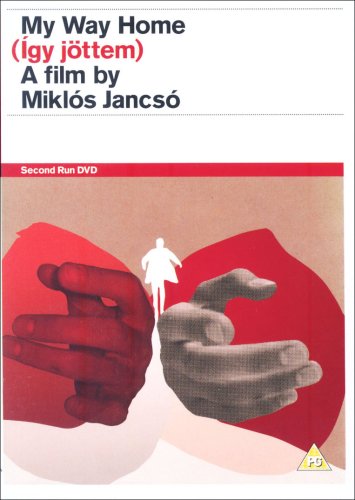
My Way Home (Jancsó)

My Way Home (Így jöttem). Miklós Jancsó, 1964.
😿
Edition screened: Second Run DVD #024, released 2007. Hungarian language with English subtitles. Runtime approximately 98 minutes.

Summary: Mild depictions of dead animals and killing of animals.

Details:
1) The two young men shoot into a river with exclamations of “Got one!” but we don’t know or see the exact targets of the mindless killing, 58:55-59:30.
2) Several dead cows are discovered, 1:04:40-1:05:30; not too graphic.

The Second Run DVD also includes Jancsó's Message of Stones Part II (1994)

@ BL

Another Way

Another Way (Egymásra nézve). Károly Makk, 1982.
😸
Edition screened: Second Run DVD #008, released 2005. Hungarian language with English subtitles. Runtime approximately 103 minutes.

Summary: No particular depictions of violence toward animals.